









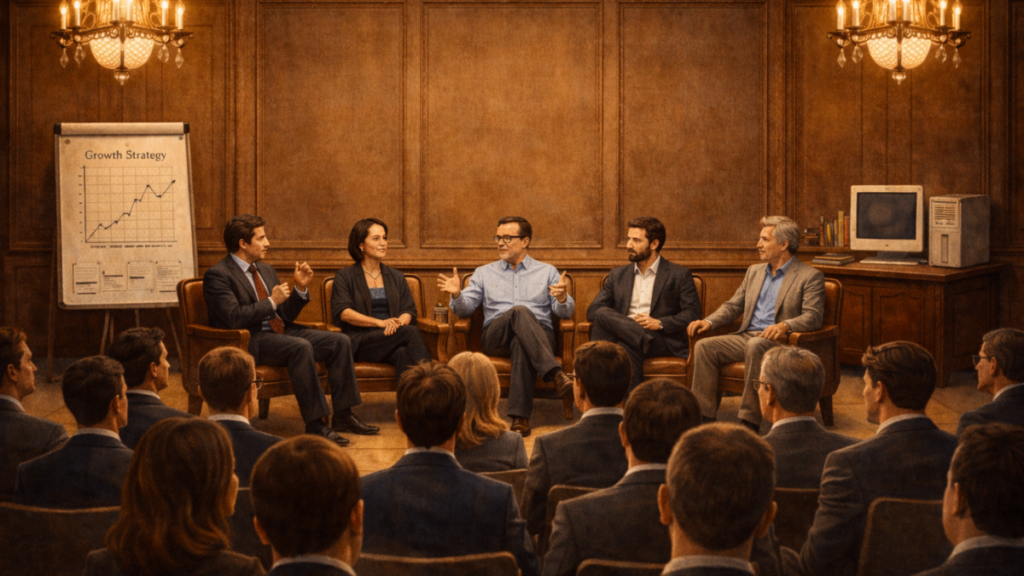
The room didn’t feel like a meetup. It felt like a checkpoint. Lower Manhattan in January has a way of sharpening people. The cold strips away pretense. So does a funding environment that has been unforgiving for half a decade. When roughly fifty founders, operators, and investors gathered inside Fabrik NYC on January 7th for Lawrence Krubner’s Startup Salon, nobody showed up for hype. They showed up because something in the old playbook is no longer working, and everyone knows it.
Krubner understands this instinctively. He didn’t frame the night as networking. He framed it as community. Fabrik itself was the proof point. A membership-based social gym where people work daily at the same back table and occasionally turn the room outward to host conversations that matter. Not a conference center. Not a demo day. A place built on proximity. The salon followed Krubner’s now-consistent format. Five speakers. Seven minutes each. No pitches. No panels. Then the real work begins in one-on-one conversations afterward. It is simple, disciplined, and quietly radical in an ecosystem addicted to scale theater.
What emerged over the next ninety minutes was not five separate talks but one continuous argument, delivered from five different angles. Mechanical solutions fail when the problem is human. And building anything that lasts in 2026 means designing around human behavior, not pretending it doesn’t exist.
Andrew Ackerman set the tone with a kind of blunt mercy that only comes from having seen too much. Twenty years investing. Over seventy startups. #Angel checks, #family office capital, Dream Ventures. He has watched more fundraising attempts die than most founders will ever attempt. His message landed because it cut through a lie many founders still cling to. Cold outreach does not work.
Ackerman described the investor inbox as a graveyard. Hundreds of emails. Most never opened. And yet founders continue to blast generic messages asking for six or seven figures, while somehow understanding that if they were selling a $50,000 enterprise #SaaS contract, they would never behave this way. They would research the buyer. Understand incentives. Craft a message that signals respect and preparation. Investors are no different. Possibly worse, because they see everything.
The deeper cut came when Ackerman addressed outsourced #fundraising. Hiring someone else to raise capital feels efficient. Investors read it as a signal that the founder didn’t care enough to do the work themselves. In two decades, the number of investments Ackerman has made from hired-gun outreach is zero. Not low. Zero. The best founders build the relationships themselves. The rest get filtered accordingly.
His framework was simple and ruthless. Build a list of fifty to a hundred relevant investors. People who have actually backed companies like yours. Then do not email them. Find warm introductions through mutual connections. When an email comes from someone an investor trusts, it gets read. Everything else is noise. This was not a growth hack. It was a reminder that capital is still a relationship business, no matter how much software wraps around it.
@Rebecca Pino followed by pulling the conversation inward. If Ackerman explained why founders fail to raise money, Pino explained why people fail to do what they already know they should do. A licensed financial advisor with deep roots in behavioral finance, Pino opened with the oldest advice in the book. Earn more. Spend less. Invest the difference. Everyone in the room had heard it. Most had failed to live it consistently.
Her point was that the advice was never the problem. The assumption behind it was. Humans are not rational. And our relationship with money is not learned in spreadsheets. It is learned before it is understood.
Pino cited Cambridge research showing that by age seven, most of our money behaviors are already formed. Not intellectually, emotionally. The tone of money in the household. The stress or calm. The silence or openness. The scripts get downloaded early and executed later. This is why two people earning the same income can experience money in completely different ways. This is not a knowledge gap. It is a behavioral inheritance.
She introduced the concept of money scripts, unconscious beliefs documented by psychologists @Ted Klontz and @Brad Klontz. More money will solve my problems. I’m not good with money. Money is stressful. These beliefs operate quietly, steering decisions until they are surfaced. Traditional financial advice fails because it ignores the human making the choice. A perfect plan that does not match someone’s nervous system, values, and lived reality will eventually collapse.
Her framework focused on coherence. Separate identity from behavior. Track without shame. Design systems that work with your tendencies instead of against them. #Automate for inconsistency. Simplify for avoidance. Create friction for impulsivity. Fund the life you are trying to build, not the one you think you can afford. When money decisions align with energy, values, and long-term vision, money stops being background noise and starts becoming a stabilizing force.
If Pino softened the room, @Keesha Jean-Baptiste sharpened it again.
With more than twenty-five years leading talent and organizational change at @Hearst, @Wieden+Kennedy, the @4A’s, and @Richemont International, Jean-Baptiste has lived inside the machinery of large organizations long enough to know where change actually dies. Her message was confrontational because it needed to be. Most change initiatives do not fail because the strategy is wrong. They fail because organizations lie to themselves about what change requires.
She outlined a six-stage cycle. Listen. Make sense. Decide. Recalibrate. Integrate. Act. Most companies are excellent at the first three. Surveys. Vision decks. Stakeholder buy-in. Then they jump straight to action, skipping the most expensive and uncomfortable parts. Recalibrating jobs. Redesigning real work. Integrating change across the organization where people actually operate.
Why do they skip it? The illusion of speed. The belief that moving faster keeps you ahead. Jean-Baptiste’s experience says the opposite. Skip job redesign and you communicate that change is optional. Everyone knows it. The problem is not process. It is honesty.
Her case study from Richemont landed hard. Leadership listened well. Crafted a coherent vision. Secured buy-in. But the change lived at the top of the organization, several degrees removed from daily work. Jobs were never recalibrated. People in the middle and bottom layers had no idea what the mandate meant for them. The initiative stalled completely.
Her diagnosis was precise. Organizations are often committed to the idea of change, not to change itself. They are unwilling to absorb discomfort, reallocate resources, risk short-term performance, or make people uncomfortable. This is not a strategy failure. It is a commitment failure. And it indicts an entire industry built around transformation theater.
@Mike Roth shifted the energy without lowering the stakes. On January 11, 2016, he joined @Flow.io as its founding engineer. The company would eventually scale from one engineer to one hundred and twenty and sell to @Global-e for $500 million in 2022. But Roth’s story did not begin with ambition. It began with a value.
Before his first day, he asked the founders what success looked like. They didn’t say IPO. They said they wanted to build a great company that people wanted to work at. That answer became the architecture.
Roth described a culture built on assumed trust, not earned trust. Anyone could submit an RFC on changes to process or technology. Decisions were debated democratically and required unanimous adoption. It sounded risky. It worked because trust pushed rigor downstream. Engineers could deploy directly to production because they owned the consequences. Testing, monitoring, and design discipline emerged not from control but from autonomy.
Ownership, Roth argued, comes from freedom, not titles. He asked candidates for their non-negotiables. Ownership. Accountability. Impact. So he designed a system where those things were possible. No permission layers. No performative hierarchy. Engineers owned work they were proud of, and the ownership came for free.
He spoke about micro-norms. Small behaviors standardized early. Even something as simple as acknowledging messages with “ack” in Slack. You were heard. These tiny signals compounded into culture. Roth personally ran onboarding long after an HR function existed, ensuring values lived in action, not documents.
Flow stayed flat for two years while scaling to one hundred and twenty #engineers by decoupling titles from compensation and creating growth paths that did not require people management. They protected what worked when they were small instead of burying it under layers. Most companies do the opposite and spend years trying to recover what they lost.
@Stephen Smith closed the night by detonating a belief many people in the room still quietly hold. At fifty-five, a serial founder and fractional CTO based in Boston, Smith had built and lost a venture-backed biotech company during the same month @FTX collapsed. When the exit vaporized, so did his sacred cows.
Instead of rebuilding the same way, Smith spent eighteen months experimenting with #low code, #no code, and #AI tools, working primarily with non-technical founders. Many of them women. Many of them excluded by traditional venture filters. He founded a community called Launch by Lunch and began watching something that would have sounded impossible ten years ago.
Companies are being built without technical cofounders. Without equity-heavy CTOs. Without the org charts Silicon Valley has treated as law since the @Netscape era.
Smith framed this as the golden age of liberal arts thinking. #AI rewards clarity, #language, and critical thinking at scale. The backlash from developers was immediate. Vibe coding. Pitchforks. But Smith’s argument was not anti-engineer. It was anti-dogma.
His case study was devastating in its simplicity. A woman with twenty years of experience as an education consultant, helping parents navigate IEPs. She hired Smith for a $10,000 fractional engagement. In three months, she had $50,000 in ARR. She raised $30,000 total, all from customers. No VCs. No equity giveaway. She shipped, sold, raised prices, and scaled demand. AI did not replace engineering. It collapsed the barrier to proving value.
Smith addressed the criticisms head-on. AI code is imperfect. Security matters. But in his experience, non-technical founders frontload security more aggressively because they expect scrutiny. AI is consistently consistent. Humans are not. And the biggest shift is economic. When you no longer need to give away twenty percent of your company to get started, entire demographics gain access to entrepreneurship.
Fifty percent of society has been structurally underfunded by venture capital. AI is not fixing bias. It is routing around it.
By the time the pizza finally arrived, no one was in a rush to leave. Krubner closed the night by naming the connective tissue in the room. Founders working on mental health. Operators. First-timers and regulars. No pitches. No deals closed in public. Just credibility accumulating quietly.
That is why this room mattered, right now. Capital is tighter. Change is harder. Old assumptions are breaking. The founders who win in 2026 will not be the loudest. They will be the most honest about human behavior. They will design for reality instead of fighting it.
Krubner announced the next salon for January 22nd, focused on #healthcare and #healthtech. The formula is working because it respects time, truth, and proximity. In an ecosystem drowning in content and starving for wisdom, that combination is rare.
The real value of this room will not show up on @LinkedIn tomorrow. It will surface six months from now in referrals, partnerships, and decisions made with clearer eyes. That is how community actually compounds.
January 7th was not about novelty. It was about five people who paid the price to learn what actually works, telling the truth in a room ready to hear it. That is why this room mattered. And why the right people will be back.



