






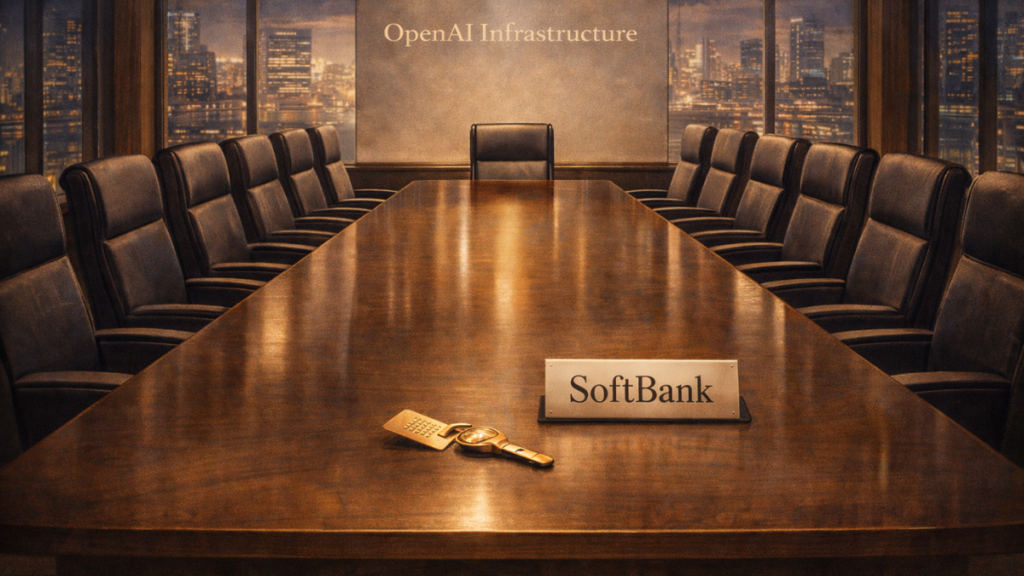
OpenAI infrastructure ownership just became explicit. SoftBank Group did not just send $40B to OpenAI Group PBC, it crossed a line global capital rarely crosses without hesitation. When the final $22.5B cleared on Dec. 26, Masayoshi Son pushed SoftBank’s ownership beyond 10%, landing near 11% of the most consequential AI company on the board. This was not portfolio management. This was conviction with teeth. Nvidia stock was sold. T Mobile trimmed. Arm Holdings leaned on. Son made the bet public and permanent.
OpenAI, founded in 2015 and headquartered in SF, has outgrown the label of model lab. Under Sam Altman, it has become an operating system for intelligence. ChatGPT now touches roughly 800M weekly users. Revenue is running past $20B ARR. But the real flex is not the product. It is the plumbing. OpenAI has lined up roughly $1.4T in long-term infrastructure commitments that turn compute scarcity into a private reserve.
The supply chain reads like a quiet takeover of the future. Nvidia locks GPU flow. AMD provides leverage and redundancy. Broadcom designs custom accelerators that bend cost curves instead of apologizing for them. Oracle, Microsoft Azure, AWS, and CoreWeave anchor cloud capacity across regions. Stargate, the joint venture with SoftBank and Oracle, targets 10 gigawatts of U.S.-based data centers. This is not renting servers. This is buying time, power, land, and certainty. At this scale, OpenAI infrastructure ownership turns compute from a market constraint into a controlled asset.
The structure matters. Altman led the conversion to a public benefit corporation, keeping mission control with the OpenAI Foundation. Bret Taylor now chairs that layer of governance. Greg Brockman is not on the sidelines. He is deep in the infrastructure build, turning commitments into concrete. On the SoftBank side, Yoshimitsu Goto engineered the balance sheet choreography that made this possible without blinking. Different titles, same direction of travel.
This moment redraws the competitive map. Models can be trained. Talent can be poached. But locked compute at this scale cannot be summoned on demand. Capital deployed this way does not chase optionality. It removes uncertainty. With SoftBank underwriting assets instead of promises, OpenAI infrastructure ownership becomes a moat competitors cannot replicate on a timetable of their choosing.